AI Executive Overview & Key Takeaways
Deterministic
No published study examines road traffic injury risk factors specifically among motorcyclists on Ha Giang Province's mountainous highway routes. Available sources describe general hazards on the Ha Giang Loop steep passes, sharp bends, narrow roads, rockslides, shifting weather, and rider fatigue.
Broader Vietnam-wide research using the Motorcycle Rider Behavior Questionnaire identifies speeding, drink-driving, helmet non-use, distraction, and poor road quality as leading risks, with head trauma the primary cause of motorcyclist deaths.
⏱️ Read: ~10 Mins
👤 Author: Giang Van A
🛡️ Verified: Editorial
📅 Ed: 2026
Table of Contents
What Makes the Ha Giang Loop Risky
Steep Mountain Passes and Sharp Switchbacks
The Ha Giang Loop winds through some of Vietnam's highest and steepest mountain terrain, including passes like Ma Pi Leng. Riders face continuous elevation changes combined with sharp switchback bends that demand constant braking, gear shifting, and precise handling. A single misjudged turn on these hairpin curves can send a rider off the road or into oncoming traffic.
Narrow Roads with Limited Visibility
Much of the route runs along narrow roads carved into cliffsides, often with no guardrails and steep drop-offs on one side. These roads are frequently shared with trucks, buses, and local traffic, leaving little margin for error. Blind corners further reduce visibility, making it difficult to anticipate oncoming vehicles.
Rockslides and Unstable Surfaces
Rockslides are a recurring hazard, particularly during and after heavy rain, which can leave debris, loose gravel, or mud on the road surface. Riders unfamiliar with the terrain may not react in time to sudden obstructions, increasing the risk of skidding or collision.
Sudden Weather Changes
Mountain weather in Ha Giang can shift rapidly, bringing fog, rain, or reduced visibility with little warning. Wet roads combined with steep grades and sharp curves significantly increase stopping distances and the likelihood of losing control.
What National Data Says About Motorcycle Risk in Vietnam
While no published study has isolated the Ha Giang Loop's mountainous passes as its own research subject, national-level research offers a reliable proxy for understanding rider risk in Vietnam, including on routes like this one. The most cited tool in this field is the Motorcycle Rider Behavior Questionnaire (MRBQ), used across multiple Vietnam-wide studies referenced by sources such as ScienceDirect and NCBI to identify the behavioral patterns most strongly linked to crashes and fatalities.
These studies consistently point to five recurring risk factors among Vietnamese motorcyclists:
Speed Violations
Riding above safe limits for road conditions is repeatedly flagged as one of the strongest predictors of crash involvement, particularly relevant on winding, high-altitude roads like those found in Ha Giang.
Drink-Driving
Alcohol impairment remains a persistent factor in motorcycle fatalities nationwide, reducing reaction time and judgment on unpredictable terrain.
Non-Use of Helmets
Despite legal helmet requirements, inconsistent or improper use is repeatedly cited as a major contributor to the severity of injuries sustained in crashes.
Distracted Riding
Phone use, conversation, and divided attention while operating a motorcycle are identified as behavioral risks that compound danger on routes requiring constant vigilance.
Unsafe Road Conditions
Poor road infrastructure, an issue also echoed in Vietnam-specific travel and safety sources describing narrow lanes, sharp bends, and changing weather, interacts with rider behavior to elevate overall risk.
Perhaps the most critical finding across this body of research is that head trauma is the leading cause of death among motorcyclists nationwide, according to NCBI-indexed studies. This finding underscores why proper helmet use is not a minor precaution but a central determinant of survival in the event of a crash. For riders tackling long, physically demanding routes such as the Ha Giang Loop, where fatigue and unfamiliar mountain roads add further complexity, these national risk patterns offer a strong evidence-based rationale for cautious speed management, sober riding, and consistent helmet use, even in the absence of location-specific injury data.
High-Risk Sections of the Loop
Not all stretches of the Ha Giang Loop carry equal risk. While the entire route winds through mountainous terrain, a handful of specific passes and segments account for a disproportionate share of the near-misses, breakdowns, and accidents reported by riders and tour operators. Understanding where these danger zones lie and why can help riders adjust their pace and caution accordingly.
Ma Pi Leng Pass
Widely cited as the most treacherous section of the entire loop, Ma Pi Leng Pass cuts through limestone cliffs above the Nho Que River, often described as one of Vietnam's "four great passes." Rider forums and tour-operator guides consistently flag this stretch for its combination of steep grades, tight hairpin turns, and sheer cliffside drops with minimal or no guardrails in many sections. According to tour operators referenced on jasminehagiang.com, the pass's narrow lanes leave little margin for error when oncoming trucks, buses, or other motorbikes need to pass, especially around blind bends.
Tham Ma Pass
Tham Ma Pass, sometimes called the "9-turn pass," is another frequently mentioned high-risk zone. Its defining feature is a rapid sequence of switchback turns descending or climbing in quick succession, which demands constant gear and brake adjustments. According to motorbiketourexpert.com, riders unfamiliar with switchback riding technique are especially prone to misjudging turn radius here, and the lack of continuous guardrail coverage means a missed turn can have severe consequences.
Common Hazards Across Danger Zones
Beyond these two named passes, tour operators and rider accounts point to several recurring hazards found throughout the loop's higher-risk sections:
- Steep grades: Sustained uphill and downhill sections strain both rider control and motorbike brakes, particularly on rented bikes that may not be well maintained.
- Hairpin and switchback turns: Tight, consecutive bends reduce visibility and require frequent speed changes, increasing the chance of skidding or misjudging the curve.
- Cliffside drops: Long vertical drops directly bordering the road amplify the consequences of even minor riding errors.
- Limited or absent guardrails: According to vietnamesemotorbiketours.com, many mountain roads in the region were not built with tourist traffic volumes in mind, and safety barriers are inconsistent or entirely missing along critical cliffside stretches.
- Weather-related degradation: Fog, rain, and rockslides can appear suddenly in these elevated sections, further reducing traction and visibility on roads already considered dangerous in dry conditions.
While formal Ha Giang-specific crash data remains limited, the consistency of rider-reported experiences and tour-operator warnings around Ma Pi Leng and Tham Ma passes suggests these sections warrant extra caution: reduced speed, full attention through blind corners, and realistic assessment of one's riding skill before attempting them independently.
Seasonal & Weather-Related Risks
Weather is one of the most unpredictable dangers on the Ha Giang Loop. The monsoon season, running roughly from May to September, brings heavy rainfall that turns mountain roads slick and unstable. Rain-slicked asphalt reduces tire grip significantly, especially on the steep passes and sharp switchbacks that define this route, making sudden braking or cornering far riskier than on dry pavement.
Persistent fog is common in Ha Giang's higher elevations, particularly during early mornings and late afternoons. Fog can cut visibility down to just a few meters, hiding oncoming trucks, sharp bends, and roadside hazards until riders are dangerously close. Combined with narrow roads and blind curves, low-visibility conditions dramatically raise the chance of collisions.
Monsoon rains also trigger landslides and rockslides along exposed mountainside routes. Loose rock, mud, and debris can appear suddenly on the road surface, especially after prolonged rain, creating unpredictable obstacles that riders may not see in time to react safely.
To manage these risks, riders should check local weather forecasts before setting out each day and adjust plans if heavy rain, fog, or storm warnings are expected. Night riding should be avoided entirely, as darkness compounds the dangers of fog, wet roads, and landslide debris, leaving little margin for reaction time. According to Vietnamese Motorbike Tours, road conditions can change rapidly in mountainous terrain, and planning travel around daylight hours and stable weather windows is one of the most effective ways to reduce seasonal risk on the Loop.
Fatigue, Experience Level & Rider Behavior
Road conditions and weather are only part of the risk equation on the Ha Giang Loop. Rider behavior how far you push yourself each day, how honestly you assess your own skill, and whether you're riding a bike suited to your experience level plays just as large a role in whether the trip stays safe.
Fatigue from Long Daily Distances
Many riders try to cram the loop into two or three days, which often means six to eight hours in the saddle navigating hairpin bends, steep passes, and broken pavement. Fatigue dulls reaction time and judgment on exactly the kind of terrain where split-second decisions matter most. According to Vital Strategies' research on motorcyclist risk perceptions in Vietnam, rider behavior factors like inattention and poor judgment are consistently linked to crash risk, and long, unbroken riding stretches make these lapses more likely. A more realistic pace spreading the loop over four days instead of two or three significantly reduces the hours of high-alertness riding required each day.
Inexperienced Riders on Semi-Automatic Bikes
A common and avoidable mistake is renting a semi-automatic (clutch) motorbike without prior experience operating one. These bikes handle differently from the fully automatic scooters most travelers are used to, requiring manual gear shifts on steep, winding descents where control is critical. According to an orthopedic surgeon's account published on Vietnam News, a large share of loop-related injuries involve riders who were unfamiliar with their bike's handling before setting out on mountain roads. Renting an automatic bike, or spending time practicing on flat, quiet roads before tackling the loop's passes, meaningfully lowers this risk.
Rest Breaks, Realistic Mileage, and Honest Self-Assessment
Building in regular rest stops helps counter fatigue-related errors, especially in the afternoon when concentration naturally drops. Riders should plan daily distances based on road difficulty rather than straight-line kilometers a stretch through Ma Pi Leng Pass takes far longer, and demands more focus, than the same distance on a flat highway. Just as important is an honest self-assessment of skill level. According to Vietnamese Motorbike Tours' guidance on road conditions, riders who overestimate their ability on unfamiliar mountain terrain are disproportionately represented in accident reports. Choosing to ride pillion, hire a driver, or take slower, shorter days isn't a compromise it's often the safer and more enjoyable way to experience the loop.
Practical Safety Tips for the Ha Giang Loop
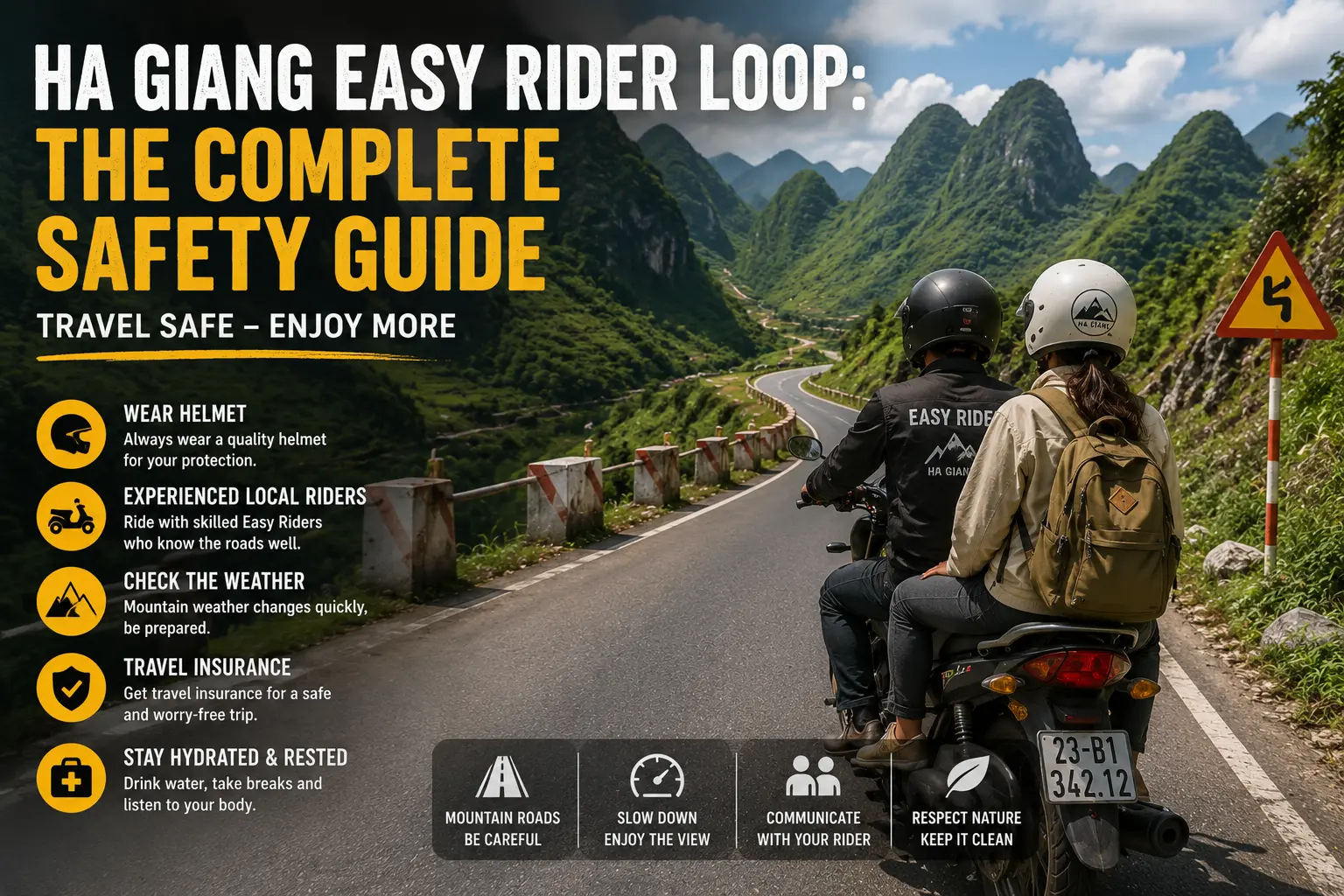
The Ha Giang Loop is a roughly 350-kilometre circuit through the karst highlands of Vietnam's northernmost province, threading past Ma Pi Leng Pass, the Nho Que River gorge and a string of border villages. It is also one of the country's least forgiving motorcycle routes: gradients that force sustained low-gear climbing, hairpin bends with no guardrail, single-lane sections shared with cargo trucks, and weather that can turn from dry to fog-bound within an hour. It is worth being clear about the evidence base here. There is no published, Ha Giang-specific epidemiological study isolating injury risk factors on these mountain highways. What exists is broader Vietnam-wide research using the Motorcycle Rider Behavior Questionnaire, which consistently identifies speed violations, drink-driving, non-use of helmets, distracted riding and poor road quality as the dominant contributors to serious motorcycle crashes, with head trauma the leading cause of death. Tour operators and regional guides describe the specific hazards of the Loop steep passes, sharp bends, narrow carriageways, rockslides and fatigue but as observed conditions rather than measured risk ratios. The practical guidance below applies the general evidence to those observed conditions.
Wear a Certified Helmet, Not a Souvenir Shell
Head injury is the single mechanism that most reliably converts a survivable crash into a fatal or disabling one. Vietnam-wide MRBQ-based research identifies non-use of helmets among the core behavioural risk factors for motorcyclist death, and orthopaedic commentary on the Loop specifically emphasises head trauma as the primary concern for foreign riders. The complication in Vietnam is that helmet compliance and helmet protection are not the same thing. The thin, brimmed "half shell" sold cheaply across the country satisfies a police check but offers minimal energy absorption and no protection to the face, jaw or temples precisely the areas that strike tarmac or rock in a low-side on a gravel-strewn bend.
Bring or rent a full-face or at minimum a three-quarter helmet carrying a recognised certification mark (DOT, ECE 22.05/22.06, or SNELL). Check the fit before you leave the rental shop: the shell should not rotate independently of your scalp when you push it side to side, and the chinstrap should admit no more than two fingers under the jaw. A correctly certified helmet that is fastened loosely will leave your head during the first impact and protect nothing.
Zero Alcohol Before You Ride
Drink-driving appears in the Vietnam-wide behavioural research as a leading risk factor, and the social structure of Loop tours makes it an unusually live hazard. Homestay evenings frequently involve communal rice wine, and there is genuine cultural pressure to accept repeated toasts. The next morning's ride begins with a climb and a series of descending switchbacks the least tolerant possible environment for delayed reaction time and degraded depth perception.
Vietnam enforces a near-zero blood alcohol threshold for riders, and enforcement has tightened. Beyond the legal exposure, alcohol undermines the two skills the Loop demands most: accurate reading of corner radius and smooth, progressive braking. Treat the rule as absolute rather than proportional one drink before riding is not a modest version of the risk, it is the risk. If the evening runs long, plan a later departure and say so to your group before you set off.
Ride in Daylight Only
Most of the Loop has no street lighting, no reflective edge marking and, in long stretches, no barrier between the carriageway and a substantial drop. Livestock, pedestrians and unlit farm vehicles use the same road surface. Regional road-condition guidance for Vietnam consistently advises against night riding on rural mountain routes, and the reasoning compounds on the Loop: oncoming high beams, fog pockets that form after sunset in the valleys, and rockfall debris that is effectively invisible until it is under your front wheel.
Build your daily schedule backwards from sunset with a buffer of at least ninety minutes. In practice this means treating 4:00–4:30 pm as your target arrival time rather than dusk, because a puncture, a weather delay or a wrong turn will consume the margin quickly. Late-season riding in November through January gives you noticeably less daylight than the summer months plan shorter daily stages accordingly.
Manage Speed Through the Curves
Speed violation is the most frequently cited behavioural factor in the Vietnamese motorcycle safety literature, and on the Loop its consequences are geometrically amplified. Ma Pi Leng and Tham Ma passes present blind hairpins where the effective sight line is a few car lengths, and where an oncoming truck will legitimately occupy part of your lane to make the turn. Sand, gravel wash from rain, and diesel spill collect on the inside of bends, so the surface with the most grip is rarely the surface your instinct chooses.
Apply the standard mountain-road discipline: complete your braking before the corner, enter wide and slow, hold a steady or gently increasing throttle through the apex, and keep to the right of your lane through blind left-handers. Use engine braking on long descents rather than riding the brake lever — sustained brake application on a small-capacity rental bike with worn pads will fade the front brake exactly where you need it. And accept that any speed which does not let you stop within your visible distance is too fast, regardless of what the road looks like it could take.
Inspect the Rental Bike Before You Commit
Unsafe road and vehicle conditions feature in the Vietnam-wide research as contributors alongside rider behaviour, and rental fleets in Ha Giang vary widely. Semi-automatic Honda models are the regional default and are mechanically well-suited to the terrain, but individual bikes accumulate hard kilometres. Run a systematic pre-rental check rather than a glance: tyre tread depth and sidewall condition, brake lever and pedal travel with a firm bite point, chain tension and lubrication, both mirrors present and adjustable, headlight and both indicators functioning, horn working (it is a genuine safety device on blind mountain bends), and no fork or fuel leaks.
Photograph the bike from all sides before departure to document existing damage, confirm what the rental agreement covers, and get the operator's phone number for breakdowns. If the shop resists a test ride or cannot fix an obvious fault, use a different shop this is the cheapest possible point at which to remove risk. Note also that Vietnamese authorities have tightened safety requirements for Ha Giang motorbike tours in recent years, including operator and licensing standards, so a provider unwilling to discuss compliance is a signal worth heeding.
Hire an Easy Rider if You Are Not an Experienced Motorcyclist
The "easy rider" model riding pillion behind an experienced local driver is the most effective single risk reduction available to an inexperienced rider, and it deserves to be framed as a legitimate choice rather than a fallback. Local drivers know which bends conceal oncoming traffic, how the passes behave in fog, where the surface has recently failed, and what the day's weather is likely to do. They also remove the two problems that most often catch visitors: unfamiliarity with Vietnamese traffic convention, and the cumulative fatigue of six hours of concentration on unfamiliar terrain.
An honest self-assessment matters more than pride. If you have not ridden a manual or semi-automatic motorcycle regularly, have never ridden on loose surfaces or sustained gradients, or do not hold a licence valid in Vietnam, the Loop is not a reasonable place to learn. It is also worth understanding the licensing position: riding without an appropriate licence and valid International Driving Permit can void travel insurance coverage entirely, which turns a moderate injury into a severe financial event. Hiring a driver preserves the entire experience of the route while transferring the technical demand to someone who does it daily.
Carry First Aid and Confirm Your Travel Insurance Covers Motorcycling
Medical infrastructure along the Loop is limited. District clinics can manage minor wounds, but serious trauma requires transfer toward Ha Giang city or onward to Hanoi several hours over the same mountain roads. That transport delay is why on-the-spot capability and pre-arranged evacuation coverage both matter more here than on a typical trip.
Carry a compact kit that addresses the injuries this terrain actually produces: sterile gauze and a pressure dressing for road rash and lacerations, antiseptic solution, adhesive tape, an elastic bandage for sprains, blister care, oral rehydration salts, any personal medication, and a foil blanket for shock or exposure at altitude. Add a headtorch and a power bank, since mobile coverage is patchy and a charged phone is your call for help.
On insurance, read the exclusions rather than the headline. Many standard travel policies exclude motorcycle riding outright, exclude engine capacities above a stated threshold, exclude riding without a locally valid licence, or exclude pillion travel. Confirm in writing that your policy covers motorcycling in Vietnam at your bike's engine size, includes emergency medical evacuation and repatriation, and specifies a realistic coverage ceiling evacuation from the northern highlands is expensive. Save the insurer's 24-hour assistance number offline, and give a copy of your policy details to someone in your group.
Putting It Together
None of these measures is exotic, and that is the point. The Vietnam-wide evidence base points repeatedly at the same short list speed, alcohol, helmets, distraction and road condition and the Ha Giang Loop simply raises the penalty attached to each one. Because no Ha Giang-specific study currently quantifies that penalty, the sensible posture is conservative: assume the general risk factors apply with greater force on steep, narrow, unbarriered mountain roads, and remove them where removal is cheap. A certified full-face helmet, a sober morning, a daylight schedule, a properly inspected bike, honest self-assessment about your riding ability, and insurance that actually covers what you are doing will address the large majority of the preventable risk on this route.
References
Giang Van A
Ha Giang Local ExpertLocal mountain guide and native culture specialist at Ha Giang Easy Rider Tour.