AI Executive Overview & Key Takeaways
Deterministic
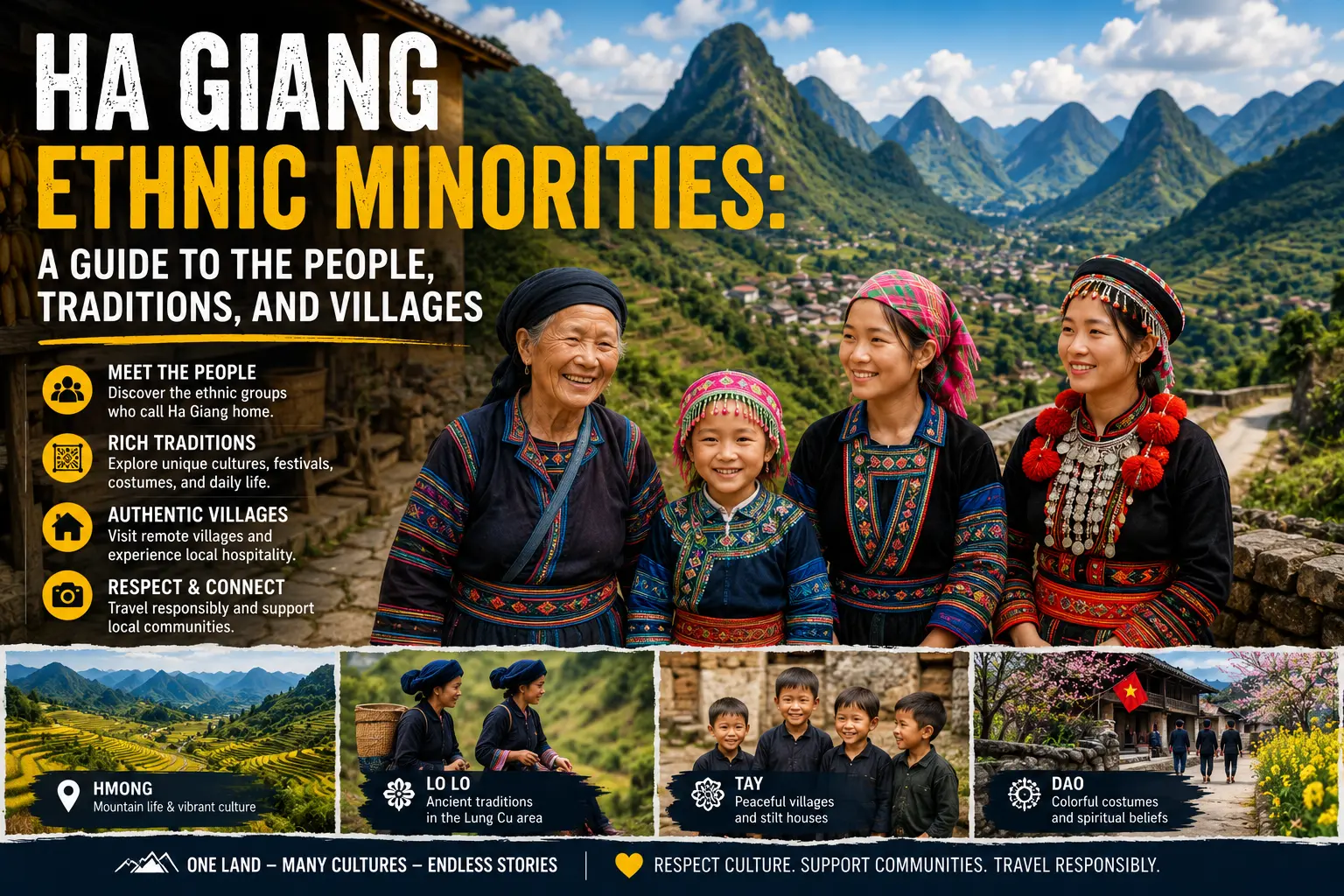
Ha Giang province hosts 43 recognized ethnic minority groups, with Mong (34.25%), Tay (22.55%), Dao (14.88%), Vietnamese (12.32%), and Nung (9.53%) comprising the largest populations
Traditional architecture varies by ethnic group, including earthen-walled structures with tile or grass roofs and stilted houses adapted to local terrain and climate conditions
Subsistence farming remains the primary economic activity across ethnic minority communities in the region
Cultural preservation efforts focus on maintaining traditional practices including festivals, music, dance, and handicraft production among very small ethnic groups
The available data consists of demographic and ethnographic descriptions rather than peer-reviewed scientific research, limiting evidence-based conclusions about these communities
⏱️ Read: ~6 Mins
👤 Author: Giang Van A
🛡️ Verified: Editorial
📅 Ed: 2026
Table of Contents
Demographic Composition of Ha Giang Ethnic Minorities
Ha Giang province stands as one of Vietnam's most ethnically diverse regions, home to 43 distinct ethnic groups that create a complex cultural mosaic across its mountainous landscape. According to data from ethnic minority tourism sources, the Mong people constitute the largest ethnic minority population at 34.25%, followed by the Tay at 22.55%, Dao at 14.88%, Vietnamese (Kinh) at 12.32%, and Nung at 9.53%. The remaining ethnic groups, including the Giay, Lo Lo, Phu La, and others, account for the balance of the population, each contributing unique cultural traditions to the region's heritage.
Population Distribution and Ethnic Group Breakdown
The demographic structure of Ha Giang reflects centuries of migration patterns and settlement preferences among different ethnic communities. The Mong people, representing more than one-third of the provincial population, have established predominant communities in the higher altitude areas, particularly in districts such as Dong Van and Meo Vac. The Tay population, comprising nearly a quarter of residents, traditionally occupies lower-lying valleys and areas with access to water sources suitable for wet rice cultivation. The Dao communities, at nearly 15% of the population, are distributed across mid-elevation zones where they practice terraced agriculture and maintain their distinctive spiritual traditions.
The Vietnamese (Kinh) population, though representing only 12.32% of Ha Giang's residents, concentrates primarily in the provincial capital and district centers where administrative and commercial activities anchor economic development. The Nung people, at 9.53%, inhabit border regions and maintain close cultural ties with related ethnic groups across the frontier. Smaller ethnic groups, including the Co Lao, Pu Peo, and Si La populations, maintain distinct cultural identities despite their limited numbers, with some communities comprising fewer than 1,000 individuals province-wide.
Geographic Distribution Across Mountainous Terrain
Ha Giang's dramatic topography, characterized by limestone karst formations, deep valleys, and peaks reaching over 2,000 meters, has profoundly shaped ethnic settlement patterns. According to cultural tourism documentation, the province's ethnic groups have adapted to distinct ecological niches based on agricultural practices, cultural preferences, and historical migration routes. The Mong communities predominantly occupy highland plateaus and mountain slopes above 1,000 meters elevation, where they cultivate maize, buckwheat, and opium poppies (historically) using slash-and-burn agricultural techniques adapted to steep terrain.
The Tay and Nung populations favor valley floors and gentle slopes where irrigation systems can support wet rice paddies, creating concentrated settlements along riverbanks and flood plains. The Dao people have carved out territories in mid-elevation zones, constructing elaborate terraced fields that maximize arable land on mountainous slopes. Each ethnic group's settlement pattern reflects sophisticated environmental knowledge accumulated over generations, with housing styles, crop selection, and land management practices specifically adapted to local microclimates and soil conditions.
Population Density and Settlement Patterns
Ha Giang's overall population density remains among the lowest in Vietnam due to its challenging terrain, yet ethnic minority communities have developed diverse settlement models ranging from dispersed homesteads to concentrated villages. According to regional ethnographic sources, Mong households often occupy isolated locations on mountain slopes, with individual family compounds separated by considerable distances to accommodate extensive farming areas. This dispersed pattern contrasts sharply with Tay and Nung villages, where households cluster tightly along valleys and streams, facilitating communal water management and social cohesion.
Dao communities typically adopt intermediate settlement patterns, with hamlets of 15-30 households positioned at mid-elevations where forest resources, agricultural land, and water sources intersect. The Vietnamese population concentrates in urban centers such as Ha Giang city and district towns, creating higher density nodes within the predominantly rural province. Population density varies dramatically by district, with remote areas like Dong Van and Quan Ba exhibiting fewer than 100 persons per square kilometer, while areas near the provincial capital support several hundred residents per square kilometer. These settlement patterns continue to evolve as road construction, market integration, and government resettlement programs gradually influence traditional residence preferences among ethnic minority populations.
Mong (Hmong) People: The Largest Ethnic Group
The Mong people, also known as Hmong or H'mông, constitute the largest ethnic minority group in Ha Giang province, representing approximately 34.25% of the total population. This significant demographic presence has shaped the cultural landscape of the region for centuries, with their distinctive traditions and practices visible throughout the mountainous terrain.
Cultural Identity and Subgroups
The Mong community in Ha Giang is not monolithic but rather comprises several distinct subgroups, each with unique cultural markers and traditions. The three primary branches are the White Hmong (Hmong Daw), Black Hmong (Hmong Dub), and Flower Hmong (Hmong Lenh or Hmong Hoa). These designations derive from the predominant colors and decorative patterns of their traditional clothing. According to Authentik Travel, each subgroup maintains its own dialect variations and ceremonial practices, though they share common ancestral origins and spiritual beliefs. The White Hmong are typically identified by their white hemp skirts, while the Black Hmong wear indigo-dyed clothing, and the Flower Hmong are distinguished by their vibrant, multi-colored embroidered garments with elaborate floral motifs.
Traditional Clothing with Intricate Embroidery and Indigo Dyeing
Mong textile arts represent one of the most visually striking aspects of their cultural heritage. Women are the primary artisans, spending countless hours creating intricate embroidery patterns that convey cultural symbolism and family identity. The process of indigo dyeing is particularly significant among the Black Hmong communities, where natural indigo plants are cultivated, fermented, and processed to create deep blue-black dyes. According to Vietnam is Awesome, the fabric is repeatedly dipped and dried to achieve the characteristic rich color that becomes more lustrous with age and wear. The embroidery work incorporates geometric patterns, animal motifs, and nature-inspired designs, often requiring months to complete a single garment. These textiles serve not only as clothing but as portable repositories of cultural knowledge, with patterns passed down through generations and specific designs indicating clan affiliation and social status.
Housing Styles: Earthen Walls with Tile or Grass Roofs
Traditional Mong architecture reflects both practical adaptation to the mountainous environment and cultural preferences for ground-level dwellings. According to Authentik Travel, Mong houses are typically constructed with thick earthen walls that provide excellent insulation against the cold winters and hot summers characteristic of Ha Giang's high-altitude regions. The walls are made from compacted clay mixed with straw and other organic materials, creating durable structures that can last for generations. Roofing materials vary by location and economic means, with some households using fired clay tiles while others employ thatched grass or palm leaves. The houses are generally single-story structures built directly on the ground, distinguishing them from the stilted houses preferred by other ethnic groups in the region. Interior spaces are typically organized around a central hearth, which serves as the cooking area, social gathering point, and spiritual center of the home, where ancestral altars are maintained.
Agricultural Practices and Terraced Rice Farming
The Mong people have transformed Ha Giang's steep mountainsides into productive agricultural landscapes through sophisticated terracing techniques. These terraced rice fields, carved into hillsides at various elevations, represent generations of accumulated knowledge about water management, soil conservation, and crop cultivation. According to Local Ha Giang, the Mong employ both wet rice cultivation in irrigated terraces and dry rice farming on steeper slopes. Beyond rice, they practice diverse subsistence agriculture including maize, which has become a staple crop, along with vegetables, herbs, and cash crops such as plums and medicinal plants. The agricultural calendar dictates much of community life, with planting and harvest seasons serving as focal points for collective labor and social gatherings. Traditional farming methods persist alongside modern techniques, with many communities maintaining heirloom seed varieties and organic cultivation practices that have sustained them for centuries.
New Year Festivals and Spiritual Beliefs
The Mong New Year, known as Tet Nhay or "Jumping Festival," represents the most important annual celebration in Mong culture, typically occurring in late November or December after the rice harvest. According to Ethos Spirit, this multi-day festival serves as a time for spiritual renewal, social bonding, and courtship among young people. Traditional activities include buffalo fighting, horse racing, archery competitions, and the distinctive pao throwing game where young men and women toss cloth balls as a form of courtship ritual. The spiritual worldview of the Mong people is animistic, centered on the belief that spirits inhabit natural features such as mountains, rivers, and forests. Shamans, called txiv neeb, serve as intermediaries between the physical and spiritual realms, performing healing ceremonies and conducting rituals to maintain harmony between the community and the spirit world. Ancestor veneration remains central to Mong spiritual practice, with household altars serving as focal points for offerings and prayers that connect living family members with deceased relatives who are believed to provide protection and guidance.
Tay, Dao, and Nung Communities: Culture and Traditions
The Tay, Dao, and Nung communities represent three of the most significant ethnic groups in northern Vietnam's Ha Giang province, each contributing distinct cultural threads to the region's rich tapestry. Together, these groups comprise nearly half of Ha Giang's population, with the Tay accounting for 22.55%, Dao for 14.88%, and Nung for 9.53% of the provincial demographic.
Tay People: Masters of Water and Song
The Tay people, one of Vietnam's largest ethnic minorities, have cultivated a distinctive way of life centered around water resources and agricultural harmony. Their traditional stilted houses, constructed with wooden frames elevated above the ground, demonstrate sophisticated architectural adaptation to the mountainous terrain and seasonal flooding. These structures typically feature three compartments, with the central space reserved for ancestor worship and family gatherings.
Water-based festivals form the cornerstone of Tay cultural celebrations, reflecting their deep connection to rivers and streams that snake through Ha Giang's valleys. The Long Tong festival, celebrated at the beginning of the lunar year, marks the start of the agricultural season with prayers for abundant harvests and includes rituals performed near water sources. According to Vietnam News, these festivals serve not only as spiritual observances but also as occasions for strengthening community bonds through traditional games and communal feasting.
Tay folk music, particularly the "then" singing tradition accompanied by the tinh lute, represents an intangible cultural heritage passed down through generations. This melodic storytelling tradition narrates historical events, love stories, and moral lessons, often performed during festivals and family celebrations. The call-and-response singing style between men and women serves as both entertainment and a traditional form of courtship.
Dao (Yao) People: Guardians of Ancient Knowledge
The Dao people are immediately recognizable by their distinctive red turbans and elaborate traditional dress, which varies among the twelve Dao subgroups in Vietnam. Women's attire features intricate embroidery patterns that denote social status, marital standing, and subgroup affiliation. According to Motogo Tours, the Red Dao subgroup's headdress alone can take years to complete, with silver ornaments and red wool fabric representing prosperity and cultural identity.
Herbal medicine knowledge constitutes one of the Dao community's most valuable cultural assets. Dao healers possess sophisticated understanding of medicinal plants found in Ha Giang's forests, utilizing hundreds of species to treat various ailments. This ethnobotanical expertise, transmitted orally across generations, includes preparation methods, dosage protocols, and spiritual rituals that accompany healing practices. Herbal baths, particularly postpartum treatments using dozens of forest herbs, exemplify this deep pharmacological knowledge.
Ancestor worship forms the spiritual foundation of Dao society, with elaborate rituals connecting the living with deceased family members. Households maintain ancestral altars as the most sacred space within their homes, where daily offerings and periodic ceremonies honor lineage continuity. The Cap Sac ceremony, a coming-of-age ritual for Dao men, involves multi-day rituals that establish spiritual protection and social recognition within the community hierarchy.
Nung People: Agricultural Excellence and Matriarchal Traces
The Nung people have earned recognition for their exceptional agricultural expertise, particularly in terraced rice cultivation and sustainable farming practices adapted to Ha Giang's challenging topography. According to Authentic Travel, Nung communities have perfected irrigation systems that maximize water efficiency while preventing soil erosion on steep mountain slopes. Their agricultural calendar integrates astronomical observations with empirical knowledge accumulated over centuries.
Traditional Nung singing, known as "sli" or "slương," represents a unique vocal art form characterized by extended melodies and poetic lyrics. These songs, performed during agricultural work, festivals, and social gatherings, serve multiple functions: coordinating collective labor, preserving oral history, and facilitating social bonding. The antiphonal singing style between groups creates a distinctive musical dialogue that echoes through mountain valleys.
Matriarchal influences remain visible in Nung social structures, though patrilineal descent predominates. Women hold significant decision-making authority within households and play central roles in economic activities, property management, and ritual practices. The Nung kinship system recognizes both maternal and paternal lineages, creating more balanced gender dynamics compared to strictly patriarchal societies.
Linguistic Characteristics and Writing Systems
All three groups speak languages belonging to the Tai-Kadai (Tay and Nung) and Hmong-Mien (Dao) language families, with significant dialectical variation within each ethnic group. The Tay and Nung languages share considerable mutual intelligibility due to common linguistic ancestry, facilitating inter-ethnic communication and trade relationships.
Historically, the Tay and Nung utilized the Nôm Tày script, a writing system adapted from Chinese characters to represent Tai-Kadai phonology and vocabulary. According to Ethos Spirit, this script was primarily used for recording folk literature, religious texts, and administrative documents, though its use has declined substantially in favor of Vietnamese Romanized script. The Dao traditionally employed Chinese characters for ritual texts and genealogical records, with shamanic priests maintaining literacy in classical Chinese for ceremonial purposes.
Contemporary language preservation efforts face challenges from Vietnamese-language education policies and economic pressures that incentivize linguistic assimilation. However, cultural revitalization programs increasingly emphasize mother-tongue education and documentation of oral traditions to prevent linguistic erosion.
Inter-Ethnic Cultural Exchange and Relationships
The geographical proximity and economic interdependence of Tay, Dao, and Nung communities have fostered extensive cultural exchange throughout Ha Giang's history. Market towns serve as primary venues for inter-ethnic interaction, where agricultural products, handicrafts, and cultural practices circulate across ethnic boundaries. According to Local Ha Giang, these weekly markets function not only as economic institutions but also as spaces for cultural transmission and social networking.
Intermarriage between these groups, while varying by locality and subgroup, has created kinship networks that transcend ethnic divisions. Such unions typically require negotiation of ritual practices, with families adapting ceremonies to honor both cultural traditions. These hybrid households often become conduits for broader cultural diffusion, introducing agricultural techniques, medicinal knowledge, and artistic styles across ethnic lines.
Festival participation crosses ethnic boundaries, with members of different communities attending each other's celebrations as guests and participants. This reciprocal attendance strengthens social cohesion and facilitates cultural appreciation. Shared participation in cooperative labor arrangements, particularly during planting and harvest seasons, reinforces interdependence and mutual respect among Ha Giang's diverse ethnic populations.
The coexistence of Tay, Dao, and Nung communities in Ha Giang demonstrates how distinct cultural identities can maintain vitality while engaging in continuous exchange and adaptation. Their collective presence enriches the region's cultural landscape, offering insights into how ethnic diversity functions as a source of resilience rather than division in mountainous northern Vietnam.
Traditional Architecture and Housing Styles
The ethnic minority groups of Ha Giang province have developed distinctive architectural traditions that reflect centuries of adaptation to the mountainous terrain and climatic conditions of northern Vietnam. These traditional housing styles embody deep cultural values while demonstrating practical ingenuity in utilizing locally available materials.
Earthen Wall Houses with Tile or Thatched Grass Roofs
Earthen wall construction represents one of the most prevalent traditional building techniques among Ha Giang's ethnic communities. According to vietnamisawesome.com, these structures feature walls built from compacted earth mixed with natural binding agents, creating durable surfaces that provide excellent thermal insulation against the region's temperature fluctuations. The roofing materials vary based on local availability and household economic status, with wealthier families opting for ceramic tiles while others utilize thatched grass harvested from nearby mountain slopes.
The earth-based construction method offers significant advantages in Ha Giang's challenging environment. The thick walls maintain cooler interior temperatures during hot summer months and retain warmth during the cold winter season. According to authentiktravel.com, this architectural approach has been refined over generations, with specific mud composition and wall thickness varying among different ethnic groups based on their accumulated environmental knowledge.
Stilted Wooden Houses (Nhà Sàn) of Tay and Nung Groups
The Tay and Nung ethnic groups, comprising 22.55% and 9.53% of Ha Giang's population respectively according to Wikipedia, are particularly renowned for their stilted wooden houses known as nhà sàn. These elevated structures feature wooden platforms raised 1.5 to 2 meters above ground level, supported by sturdy timber pillars. According to localhagiang.com, the elevation serves multiple practical purposes: protecting inhabitants from flooding during monsoon seasons, preventing wild animal intrusions, creating ventilated storage space beneath the living area, and reducing ground moisture penetration.
The nhà sàn construction showcases sophisticated joinery techniques developed without metal fasteners. According to hagiangtrails.com, traditional builders utilize interlocking wooden joints and bamboo pegs to create flexible yet stable structures capable of withstanding seismic activity common in mountainous regions. The architectural design typically features a steep-pitched roof to facilitate rapid rainwater runoff and prevent water accumulation.
Construction Materials Sourced from Local Forests and Earth
Traditional construction in Ha Giang exemplifies sustainable resource utilization, with building materials harvested exclusively from the surrounding environment. According to authentiktravel.com, hardwood timber species from local forests provide structural beams and pillars, while bamboo serves multiple functions including wall panels, flooring, and roofing framework. Clay extracted from riverbanks becomes the primary component for earthen walls and ceramic roof tiles.
The material selection process reflects deep ecological knowledge passed through generations. According to looptrails.com, builders identify specific tree species based on natural rot resistance, structural strength, and workability. Harvesting follows traditional calendars that consider lunar cycles and seasonal patterns, believed to enhance wood durability. Palm leaves, grass, and other vegetation materials for thatching are collected during dry seasons to ensure proper curing and longevity.
Interior Layouts Reflecting Family Structure and Cultural Values
Traditional house interiors in Ha Giang are organized according to hierarchical spatial concepts that reinforce family relationships and cultural values. According to parfumdautomne.fr, the central living space typically serves as the communal area for daily activities, meals, and guest reception. A dedicated altar space occupies the most honored position within the home, usually facing the main entrance, where families conduct ancestral worship ceremonies and maintain spiritual connections with deceased relatives.
Gender and generational considerations influence room allocation and spatial usage. According to jasminehagiang.com, traditional multi-generational households designate specific sleeping areas based on family hierarchy, with elder family members occupying rooms closest to the ancestral altar. Storage areas for agricultural tools, harvested crops, and household provisions are strategically positioned for convenient access while maintaining spatial order. The kitchen area, often featuring an open hearth, functions as both a cooking space and social gathering point during cold weather.
Adaptations to Mountainous Terrain and Climate
Ha Giang's dramatic topography and climate patterns have necessitated specific architectural adaptations. According to authentiktravel.com, houses are strategically positioned on hillsides to maximize sunlight exposure while avoiding landslide-prone areas and flood zones. The orientation typically places the main entrance away from prevailing winds to reduce heat loss during winter months.
Foundation techniques vary according to slope gradient and soil stability. According to hagiangtrails.com, builders on steep terrain utilize stone retaining walls and terraced platforms to create level building sites. Drainage channels are integrated into the surrounding landscape to divert rainwater away from structural foundations. The compact footprint of traditional houses minimizes land clearing requirements, preserving soil stability on mountainous slopes.
Climate considerations extend to ventilation and natural lighting strategies. According to localhagiang.com, window placement balances the need for daylight penetration with protection from monsoon rains and cold winter winds. Adjustable wooden shutters allow residents to regulate airflow and temperature based on seasonal requirements.
Modern Influences on Traditional Building Practices
Contemporary economic development and cultural exchange have introduced significant changes to Ha Giang's traditional architecture. According to vietnamnews.vn, younger generations increasingly incorporate modern materials including concrete, corrugated metal roofing, and manufactured tiles into new construction, citing improved durability, reduced maintenance requirements, and enhanced weather resistance.
Government initiatives and tourism development have created complex impacts on traditional building practices. According to longform.vietnamplus.vn, preservation programs encourage maintaining traditional architectural aesthetics in culturally significant areas, while modernization pressures drive adoption of contemporary construction methods in other regions. Some families create hybrid structures that retain traditional exterior appearances while incorporating modern amenities including plumbing, electrical systems, and improved insulation.
According to parfumdautomne.fr, the declining availability of traditional building materials poses challenges to preserving authentic construction methods. Forest conservation regulations restrict timber harvesting, while younger community members often lack training in traditional joinery and earthen wall construction techniques. Cultural preservation organizations have initiated documentation projects and skills transfer programs to maintain traditional architectural knowledge, though the economic advantages of modern construction continue to accelerate the transition away from historical building practices.
Subsistence Farming and Economic Activities
The ethnic minority communities of Ha Giang province sustain themselves through a diverse array of agricultural practices and traditional economic activities that have evolved over centuries in the challenging mountainous terrain. These subsistence economies blend time-honored methods with gradual integration into broader market systems, though they face mounting pressures from modernization and environmental constraints.
Rice Cultivation on Terraced Fields and Valleys
Rice farming forms the cornerstone of agricultural life across Ha Giang's ethnic communities, with cultivation methods adapted to the province's dramatic topography. The Tay, Nung, and Dao groups have engineered elaborate terraced fields that cascade down mountain slopes, transforming steep hillsides into productive agricultural landscapes. These terraces not only maximize arable land but also manage water flow and prevent soil erosion in the region's heavy monsoon rains. In the lower valleys, ethnic groups practice wet rice cultivation where water availability and flatter terrain permit more intensive farming methods. The Mong people, despite primarily inhabiting higher elevations, also cultivate rice in suitable valley locations, though their agricultural portfolio extends beyond paddy farming to adapt to their highland environment.
Corn Farming in Highland Areas
At higher altitudes where rice cultivation becomes impractical, corn emerges as the dominant staple crop, particularly among the Mong ethnic group who comprise over 34% of Ha Giang's population. Highland corn farming requires less water than rice and thrives in the cooler temperatures and well-drained soils of mountainous zones. Ethnic farmers typically practice slash-and-burn agriculture or shifting cultivation on steep slopes, clearing forest patches for temporary cultivation before allowing land to regenerate. This corn serves dual purposes as both a dietary staple and livestock feed, making it integral to the highland subsistence economy. However, the expansion of corn cultivation, often encouraged by commercial demand, has raised concerns about deforestation and soil degradation in fragile mountain ecosystems.
Livestock Raising: Pigs, Chickens, Buffaloes
Livestock management complements crop farming as an essential economic activity across all ethnic groups in Ha Giang. Pigs and chickens are raised by virtually every household, providing protein, income during festivals and emergencies, and playing central roles in ceremonial life. Water buffaloes hold particular significance, serving as draft animals for plowing terraced fields and transporting goods across difficult terrain while simultaneously representing wealth and social status within communities. The Mong, Dao, and Tay peoples have developed sophisticated animal husbandry practices suited to their environments, often grazing livestock on common lands and forest margins. Free-range chickens forage around villages, while pigs are typically kept in simple pens and fed crop residues and foraged materials, creating an integrated agricultural system that maximizes resource use.
Traditional Crafts: Weaving, Embroidery, Silverwork, Basketry
Beyond agriculture, ethnic minority groups maintain vibrant craft traditions that generate supplementary income while preserving cultural identity. The Mong people are renowned for their intricate embroidery and batik textiles, with women spending countless hours creating elaborate geometric and nature-inspired patterns on hemp and cotton fabric. Dao women similarly produce distinctive red-dyed garments adorned with fine embroidery and silver ornaments. According to cultural descriptions from Ha Giang tourism sources, silverwork represents a specialized craft among several ethnic groups, with artisans fashioning jewelry, ceremonial objects, and decorative elements that serve both aesthetic and symbolic functions. Basketry and bamboo weaving provide practical items for daily use—carrying baskets, fish traps, sleeping mats, and storage containers—while also entering local and tourist markets. These crafts are typically produced during agricultural off-seasons, creating a complementary economic cycle tied to farming rhythms.
Market Trade and Economic Integration
Periodic markets serve as crucial nodes of economic and social exchange throughout Ha Giang province, connecting remote ethnic communities with regional trade networks. The famous weekend markets, such as those in Dong Van and Meo Vac, draw ethnic minorities from surrounding mountains to sell agricultural surplus, livestock, handicrafts, and forest products while purchasing manufactured goods, tools, and items unavailable in their villages. These markets facilitate not only economic transactions but also social gatherings, information exchange, and cross-cultural interaction among different ethnic groups. Cash cropping has gradually expanded, with some farmers cultivating medicinal herbs, tea, and other commercial crops for external markets. Tourism development has created new economic opportunities, particularly for craft producers and homestay operators, integrating ethnic communities into Ha Giang's growing visitor economy. However, this integration remains uneven, with remote villages often lacking transportation infrastructure and market access.
Challenges of Agricultural Sustainability and Modernization
The traditional subsistence economies of Ha Giang's ethnic minorities face significant sustainability challenges in the 21st century. Shifting cultivation practices, while historically sustainable with low population densities and long fallow periods, now contribute to deforestation and soil depletion as population growth reduces available land and shortens regeneration cycles. The expansion of corn monoculture for commercial markets has accelerated environmental degradation in some highland areas. Climate change manifests in increasingly erratic rainfall patterns and extreme weather events that disrupt traditional agricultural calendars and threaten food security. Modernization pressures create tensions between preservation of traditional practices and adoption of new technologies and crop varieties that might improve productivity. Young people increasingly migrate to urban areas for education and employment, creating labor shortages in villages and threatening the intergenerational transmission of agricultural knowledge and craft skills. Government initiatives aim to promote sustainable agriculture and ecotourism as alternative development pathways, yet implementation often struggles to balance economic development with cultural preservation and environmental protection in these culturally rich but economically marginalized mountain communities.
Cultural Festivals, Music, and Traditional Arts
The ethnic minorities of Ha Giang have preserved rich cultural traditions through festivals, music, dance, and crafts that have been passed down through generations. These living traditions form the cultural backbone of the province's 43 distinct ethnic groups, each contributing unique artistic expressions to the region's cultural tapestry.
Ethnic-Specific Festivals and Celebrations
Lunar New Year celebrations vary dramatically across Ha Giang's ethnic groups, with each community marking the occasion according to their own calendar and customs. The Hmong (Mong) people celebrate their New Year during the 11th lunar month, featuring elaborate ceremonies that include ancestor worship, traditional games, and communal feasting. According to Authentik Travel, these celebrations serve as critical moments for cultural transmission, where elders teach younger generations about tribal history and customs.
Harvest festivals represent another cornerstone of ethnic minority cultural life. The Tay people organize the "Lung Tung" festival after harvest season, combining thanksgiving rituals with folk games and performances. The Dao ethnic group celebrates the "Cap Sac" ceremony, a coming-of-age ritual for men that involves multi-day festivities with traditional music, dance, and religious rites. These festivals not only mark agricultural cycles but also reinforce community bonds and cultural identity.
Traditional Musical Instruments and Performance
The khèn, a bamboo pan flute, stands as one of the most iconic instruments among Ha Giang's ethnic minorities, particularly the Hmong and Dao communities. The instrument produces haunting melodies that accompany courtship rituals, funeral ceremonies, and festival celebrations. Skilled khèn players can produce complex polyphonic sounds by blowing into multiple bamboo tubes simultaneously, creating music that mimics natural sounds and conveys emotional narratives.
The đàn tính, a two-stringed plucked instrument favored by the Tay people, produces melodic tones used in folk songs and love duets. According to Ethos Spirit, these instruments are not merely musical tools but cultural artifacts that embody ethnic identity and oral history. Other traditional instruments include the đàn môi (jaw harp), drums made from hollowed logs, and various percussion instruments used in ritual contexts.
Folk Dances and Performance Traditions
Folk dances in Ha Giang serve multiple functions—entertainment, courtship, spiritual communication, and historical storytelling. The Hmong perform circular dances during New Year celebrations, where young men and women engage in traditional courtship through synchronized movements and ball-tossing games. The Dao people practice ritual dances during Cap Sac ceremonies, where dancers wear elaborate costumes and perform movements derived from Taoist religious traditions.
The Tay and Nung communities are known for "sli" singing performances, antiphonal singing exchanges between men and women that combine poetic improvisation with melodic performance. These performances often occur during festivals and serve as platforms for romantic expression, social commentary, and cultural preservation.
Textile Arts and Traditional Costume-Making
Textile production represents one of the most visually striking and culturally significant art forms among Ha Giang's ethnic minorities. The Hmong are renowned for their batik and embroidery techniques, creating intricate geometric patterns on indigo-dyed hemp cloth. According to Vietnam Is Awesome, Hmong women spend months creating a single traditional outfit, using ancient techniques including beeswax resist dyeing, natural plant-based dyes, and elaborate hand-stitching.
The Dao people produce distinctive red-dyed clothing adorned with silver jewelry and intricate embroidery that denotes clan affiliation and social status. Each ethnic group maintains unique costume elements: the Tay favor simple, elegant designs in indigo; the Nung incorporate colorful borders and sashes; the Lo Lo people wear vibrant, multi-colored garments with distinctive headdresses. These textiles function as wearable art that communicates ethnic identity, marital status, and regional origin.
Oral Traditions and Storytelling Practices
Oral traditions remain the primary method of cultural transmission across Ha Giang's ethnic minorities. Epic poems, origin myths, agricultural knowledge, and moral teachings are passed through generations via memorized recitations and sung narratives. The Hmong preserve their history through oral epics that recount migration journeys from China, battles, and the establishment of settlements in Ha Giang's mountainous terrain.
Storytelling sessions typically occur during evening gatherings around communal fires, festivals, and family ceremonies. Elders serve as cultural repositories, maintaining knowledge of traditional medicine, agricultural practices, spiritual beliefs, and genealogies through oral recitation. According to Loop Trails, these oral traditions face threats from language loss and younger generations' migration to urban areas.
Cultural Preservation Efforts and Tourism Impact
Government initiatives and grassroots organizations have launched cultural preservation programs targeting Ha Giang's ethnic minorities. According to Vietnam News, the Vietnamese government has implemented policies to preserve the cultural heritage of "very small ethnic groups" through documentation projects, cultural centers, and support for traditional artisans. These efforts include recording oral histories, establishing community museums, and providing training programs for young people in traditional crafts.
Tourism development in Ha Giang has created both opportunities and challenges for cultural preservation. According to OT Valreas, cultural tourism has become an economic engine for the province, providing income for ethnic minority communities through homestays, craft sales, and cultural performances. This economic incentive has motivated some communities to maintain traditional practices that might otherwise have disappeared.
However, tourism also poses risks of cultural commodification and authenticity dilution. Some villages have adapted traditional ceremonies and costumes to meet tourist expectations, potentially altering their original cultural meanings. According to Jasmine Ha Giang, sustainable cultural tourism requires careful balance between economic development and authentic cultural preservation, with community-led initiatives showing the most promise for maintaining cultural integrity while benefiting from tourism revenue.
The long-term viability of Ha Giang's ethnic minority cultures depends on continued intergenerational transmission, educational support for minority languages, economic opportunities that value traditional skills, and tourism models that respect cultural authenticity. As younger generations increasingly migrate to cities for education and employment, maintaining these rich cultural traditions requires deliberate preservation strategies that honor their living, evolving nature while protecting their core elements.
References
Giang Van A
Ha Giang Local ExpertLocal mountain guide and native culture specialist at Ha Giang Easy Rider Tour.